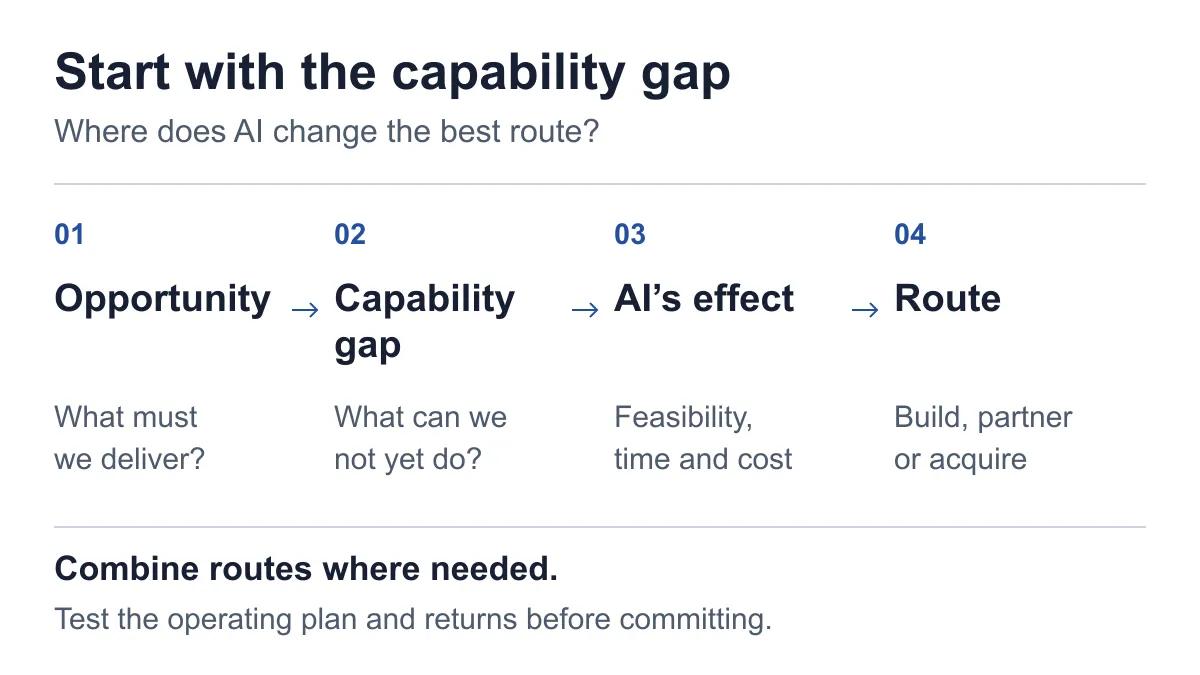
On this page 7
It has been a while since I wrote about business strategy. I’m revisiting an earlier research piece of mine on the choice between building, partnering and acquiring, this time looking at how recent advances in AI could change the decision.
Imagine a manufacturer considering a new industrial component. Customers want it, the company has a sales network, and there is room in its plant. But it cannot yet produce the component at the required quality and cost. A specialist business has the process expertise it needs.
The manufacturer could develop its own process, create one with the specialist, or acquire the business. AI-assisted research and design might shorten development. They would still leave questions about production yield, intellectual property, customer qualification and the people needed to run the operation.
For this manufacturer, the decision turns on whether it can obtain a dependable production capability in time to serve the market. That is the gap to assess before putting a price on a target or committing to an internal programme.
AI belongs in that assessment. Which development steps can it improve, and would those improvements change the preferred route?
Specify the capability before choosing the route
“Enter this market” is an ambition. “Supply this component at the customer’s specification, at an acceptable margin, within eighteen months” is a requirement against which the choices can be assessed.
Meeting it may require several capabilities working together:
| What must work | What management needs to establish |
|---|---|
| Product and process know-how | Can we design it, protect what is distinctive and use the necessary IP? |
| Production and quality | Can we deliver consistent output at the required cost and scale? |
| Data and learning | Can we obtain, use and interpret the information that improves performance? |
| Customer access | Can we win approval, secure orders and support customers after delivery? |
| People and coordination | Can the teams operate these activities together and respond when something fails? |
A list of assets will not answer those questions. A plant needs a repeatable process and people who can maintain it. A patent may protect an invention while leaving substantial development work unfinished. A customer list has limited value if the relationships do not survive a change of owner.
Next, distinguish what already works from what must be improved or obtained. In the manufacturer’s case, customer access and general production capacity may be strengths. The specialist process may be the constraint. A purchase that secures that process deserves a different valuation from one that mainly duplicates capabilities the company already has.
This is the starting discipline in Laurence Capron’s Build, Borrow or Buy framework: assess whether existing resources can support internal development before deciding how to obtain resources externally. Her research with Will Mitchell also examines how capability gaps and internal organisational constraints affect that choice. INSEAD, 2012; Capron and Mitchell, 2009
Work out what AI actually changes
For each missing capability, ask which work can become faster, cheaper or more reliable, and what still has to happen afterwards.
For the manufacturer, AI might help explore designs or analyse process data. Whether that makes internal development competitive depends on the next steps: testing, repeatability, production economics and customer acceptance. A faster design cycle is useful only to the extent that it improves the route to a saleable component.
The relevant comparison is therefore the full development plan with and without the proposed tools. Include specialist hiring, experiments, training, implementation and the cost of failed attempts. Measure time to dependable output as well as time to a promising prototype.
Research on the Productivity J-Curve provides a useful caution. General-purpose technologies can require substantial complementary investment in skills, processes and organisational changes before their benefits become visible. It supports including those investments; it does not supply a universal percentage saving for an AI-enabled project. Brynjolfsson, Rock and Syverson, 2021
AI can also change the value of the external option. If a specialist’s know-how becomes easier to reproduce, paying a large premium for it becomes harder to justify. If better tools make a scarce dataset, production process or distribution network more useful, the owner may become a more valuable partner or acquisition target. Those are hypotheses to test against the particular capability.
Choose a route for each gap
The company does not have to make one choice for the entire opportunity. It might develop its product, license a process, share development of a critical component and acquire a team. Each arrangement must fit with the others.
BCG’s September 2026 analysis of AI dealmaking makes a helpful distinction: assess how much a capability can differentiate the business and how readily comparable alternatives are available. These questions help establish whether ownership adds something that ordinary access cannot provide. BCG, 2026
Build when the company has a credible path to developing the capability. Relevant experience, suitable people and the ability to learn from repeated use all matter. So does the time available. In the manufacturing example, an internal team with adjacent process expertise may be able to develop the missing step. AI could improve that case if trials demonstrate a meaningful reduction in development time or cost.
The commitment includes operating and improving the capability after launch. A build proposal should identify who will own that responsibility, what must be learned, and when the evidence would justify stopping or changing course. Internal development can preserve valuable learning. It can also consume years pursuing a capability that was available elsewhere.
Partner when the organisations can contribute complementary capabilities and work together effectively. The manufacturer might bring production capacity and customer relationships; the specialist might bring process expertise. They could jointly develop a production method, share the investment and divide the resulting returns.
The value comes from those contributions working together. Before committing, establish who funds development, who operates the process, who owns improvements and who can use them elsewhere. Agree how capacity, pricing and disputes will be handled. A partner that controls an essential input may gain bargaining power after the other company has invested heavily. A staged agreement should test both technical performance and the ability to cooperate.
Acquire when common ownership materially improves access, coordination or control, and the business can be combined successfully. Some capabilities reside in a team, its routines and its accumulated experience. A licence may transfer formal rights while leaving much of that operating knowledge behind. Acquisition can bring those elements together, but only if the people stay and the capability survives integration.
Ask what the buyer contributes as well. Its customer access, facilities or capital may help an acquired capability reach a scale the target could not achieve alone. McKinsey’s Buy and scale analysis describes this explicitly, including access to manufacturing capacity, purchasing, IP and customers. These benefits need an operating plan and accountable owners. McKinsey, 2022
Owning the target is still a commitment to the rest of that business, including activities the buyer may not need. A minority investment, licence, joint venture or asset purchase may close the gap with less complexity. The comparison should include those structures where they are feasible.
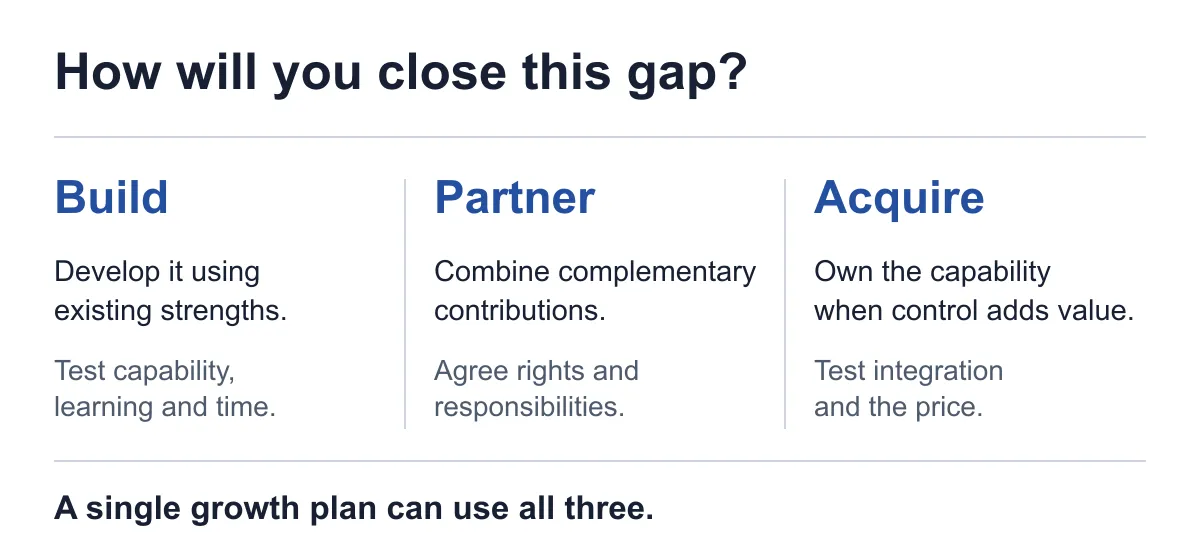
Apply these tests to each material gap. A single growth plan can combine several routes.
Two public examples of combining capabilities
BMW and Toyota’s hydrogen collaboration shows how shared technology can support distinct products. In September 2024, the companies announced joint development of a next-generation fuel-cell powertrain. They planned to use the technology in distinct vehicles while combining development and procurement volumes. BMW said it intended to launch its first series-production fuel-cell vehicle in 2028. BMW announcement
The arrangement combines a shared technical effort with separate branded products. It also recognises a dependency beyond either vehicle: hydrogen infrastructure. It illustrates how a partnership can address part of a capability system while leaving important market risks unresolved. The announcement establishes the intended structure, rather than proving its eventual commercial returns.
Thermo Fisher’s acquisition of Olink illustrates buying a complementary scientific capability. Olink’s proprietary Proximity Extension Assay technology enables protein analysis. In announcing the deal in October 2023, Thermo Fisher linked that technology to its existing mass-spectrometry offering and its ability to support wider adoption. It completed the acquisition on 10 July 2024, reporting a transaction value of approximately $3.1 billion, net of $96 million of acquired cash. Acquisition announcement; completion
The rationale rests on combining an established assay capability with a broader scientific and commercial business. Assessing whether ownership justified the price would require evidence about the alternatives and subsequent results.
These examples illustrate capability strategy; they do not show that AI favoured either route. The same questions about contributions, coordination and delivery need to be answered when AI changes part of an opportunity.
Put the operating plan before the price
Once the routes are sufficiently defined, compare their economics against the same commercial objective. Allow for genuine differences in launch date, quality, scale and risk. A route that launches sooner but cannot meet a customer’s specification is not an equivalent alternative.
Include deferring entry or taking no action. An identifiable market gap can still be unattractive once the cost of serving it is understood.
For a build, include development, learning, equipment, operating costs and the cost of delay. For a partnership, include the company’s own contribution, partner payments, coordination costs and dependence on future terms. For an acquisition, include the price, integration, investment still required and any disruption to the existing businesses. Deduct each cost once.
For the manufacturer, the strongest evidence may be a production trial showing consistent yield, a customer qualification milestone and a clear allocation of operating responsibilities. Those findings should drive the forecast. A spreadsheet cannot supply the missing evidence.
An acquisition’s strategic logic and its price remain separate tests. The maximum price should reflect what the business is worth to this buyer after the costs of combining it, while leaving the buyer at least as well off as its best feasible alternative. Damodaran’s acquisition valuation work makes the essential distinction between creating benefits through a combination and paying those benefits away to the seller. NYU Stern
Where uncertainty is substantial, sequence the commitments. A paid trial or joint-development phase may establish whether the capability works and the organisations can collaborate before a larger investment. Set the next decision date and the evidence required. Waiting also has costs when customers, learning or scarce assets are being lost.
Where advantage is likely to move
As tools improve, companies should expect the relative scarcity of capabilities to change. My expectation is that advantages based on work competitors can readily reproduce will face more pressure. Greater value may attach to the complementary capabilities that still constrain delivery: reliable production, relevant data that can actually be used, protected know-how, customer acceptance or effective distribution.
That is a conditional view, rather than a claim that every factory, patent or customer base becomes more valuable. A factory needs demand and competitive economics. Data must improve decisions or outcomes. A customer relationship must support future business. AI can strengthen or weaken each investment case.
David Teece’s research on profiting from innovation explains why this distinction matters: returns depend partly on how an innovation is protected and who controls the complementary assets needed to commercialise it. The invention and the ability to earn a return from it are connected through those assets. Teece, 1986
For the manufacturer, the next decision is concrete: test whether the missing process can be developed internally, establish what collaboration would require, and determine what acquisition would add. Update those options as evidence about AI, production and customers improves.
The route should follow the capability gap. AI changes the possibilities and the economics; management still has to assemble a business that can deliver.
References
- Capron, L. (3 May 2012). The Corporate Growth Dilemma: Build, Borrow or Buy?. INSEAD Knowledge.
- Capron, L. and Mitchell, W. (2009). Selection Capability: How Capability Gaps and Internal Social Frictions Affect Internal and External Strategic Renewal. Organization Science, 20(2), 294–312.
- Brynjolfsson, E., Rock, D. and Syverson, C. (2021). The Productivity J-Curve: How Intangibles Complement General Purpose Technologies. American Economic Journal: Macroeconomics, 13(1), 333–372.
- Kengelbach, J., Friedman, D., Pot, L., Keienburg, G. and Söllner, T. (21 September 2026). How Non-AI Companies Win at AI Dealmaking. BCG, The 2026 M&A Report.
- Berger-de León, M., Jenkins, P., Königsfeld, J. and Salomon, L. (21 December 2022). Buy and scale: How incumbents can use M&A to grow new businesses. McKinsey.
- BMW Group (5 September 2024). Hydrogen Pioneers: BMW Group and Toyota Motor Corporation take collaboration to the next level. Company announcement.
- Thermo Fisher Scientific (17 October 2023). Thermo Fisher Scientific to Acquire Olink, a Leader in Next-Generation Proteomics. Company announcement.
- Thermo Fisher Scientific (10 July 2024). Thermo Fisher Scientific Completes Acquisition of Olink, Announces Commencement of Subsequent Offering Period. Company announcement.
- Damodaran, A. (undated). Acquisitions in Capital Expenditures. NYU Stern valuation teaching note.
- Teece, D. J. (1986). Profiting from technological innovation: Implications for integration, collaboration, licensing and public policy. Research Policy, 15(6), 285–305.